Indicators / Trend / ADX
ADX and DMI Explained: Measuring Trend Strength
Quick answer
ADX (Average Directional Index) measures how strong a trend is, not which way it is going. Readings above about 25 suggest a trending market; below 20 suggests a range. The +DI and −DI lines that come with it show whether buyers or sellers are driving.
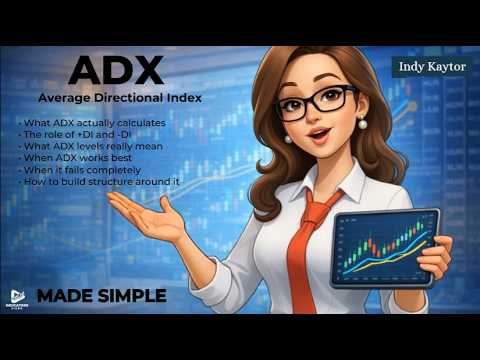
Video: DMI/ADX for Beginners.
What ADX measures
ADX turns trend strength into a number from 0 to 100. It is the same whether the trend is up or down. Its job is to answer one question before you pick a strategy: is this market trending at all?
How ADX and DMI are calculated
+DI measures upward movement and −DI measures downward movement, each smoothed over 14 periods and scaled by the average true range. ADX is the smoothed difference between them:
ADX = 14-period smoothed average of DX
The ADX scale
| ADX | Reading |
|---|---|
| Below 20 | Weak or no trend; range tools work better |
| 20 to 25 | A trend may be forming |
| 25 to 40 | Trending; trend tools work better |
| Above 40 | Very strong trend, often late in the move |
The default length is 14.
How to read ADX
1. Choose the strategy
Rising ADX above 25: favour trend-following tools like moving averages and SuperTrend. Low or falling ADX: favour range tools like pivot points and classic RSI levels.
2. Direction from DI
+DI above −DI means buyers are driving; the reverse means sellers are. A DI cross with ADX rising is more meaningful than one with ADX falling.
3. Falling ADX is not a reversal
When ADX turns down from a high level, the trend is losing strength. Price may simply pause or move sideways.
Common mistakes
- Reading ADX as direction. A high ADX can be a strong downtrend.
- Trading every DI cross. In low-ADX markets they are noise.
- Expecting it to be early. ADX is heavily smoothed and lags.
What to pair ADX with
- RSI, read as strength in a trend and classically in a range.
- Moving averages for direction.
- Bollinger Bands to spot volatility expansions.
ADX FAQ
What is a good ADX level?
Above 25 is usually treated as a trending market, and below 20 as a range.
Does ADX show trend direction?
No. ADX shows strength only. Use +DI and −DI, or price itself, for direction.
What does a falling ADX mean?
The trend is losing strength. It does not mean price will reverse.